AI arbitrage is one of those terms that sounds exciting — and confusing — at the same time. After researching multiple high-ranking U.S. articles, reviews, agency guides, and real business use cases, one thing became clear: most content either overhypes AI arbitrage or explains only one side of it.
This guide is different.
I’ve carefully studied what is AI arbitrage? how AI arbitrage is explained across trading platforms, agency models, and retail reselling strategies. I’ve compared what top websites say and, more importantly, what they don’t explain clearly. The goal of this article is simple: Give you a complete, honest, and easy-to-understand explanation of AI arbitrage without confusion or hype.
If you’re a beginner, student, side hustler, or small business owner in the U.S., this guide will help you understand exactly what AI arbitrage is, how it works, and whether it’s right for you.
Table of Contents
- What Is AI Arbitrage?
- How Is AI Arbitrage Different From Traditional Arbitrage?
- Types of AI Arbitrage (Most Articles Miss This)
- How Does AI Arbitrage Actually Work?
- Can You Really Make Money With AI Arbitrage?
- AI Arbitrage vs Traditional Reselling vs Manual Work
- Common AI Tools Used in AI Arbitrage
- Is AI Arbitrage Legal in the U.S.?
- Risks and Downsides of AI Arbitrage
- Is AI Arbitrage a Scam?
- Who Is AI Arbitrage Best For?
- The Future of AI Arbitrage
- Final Thoughts
What Is AI Arbitrage?
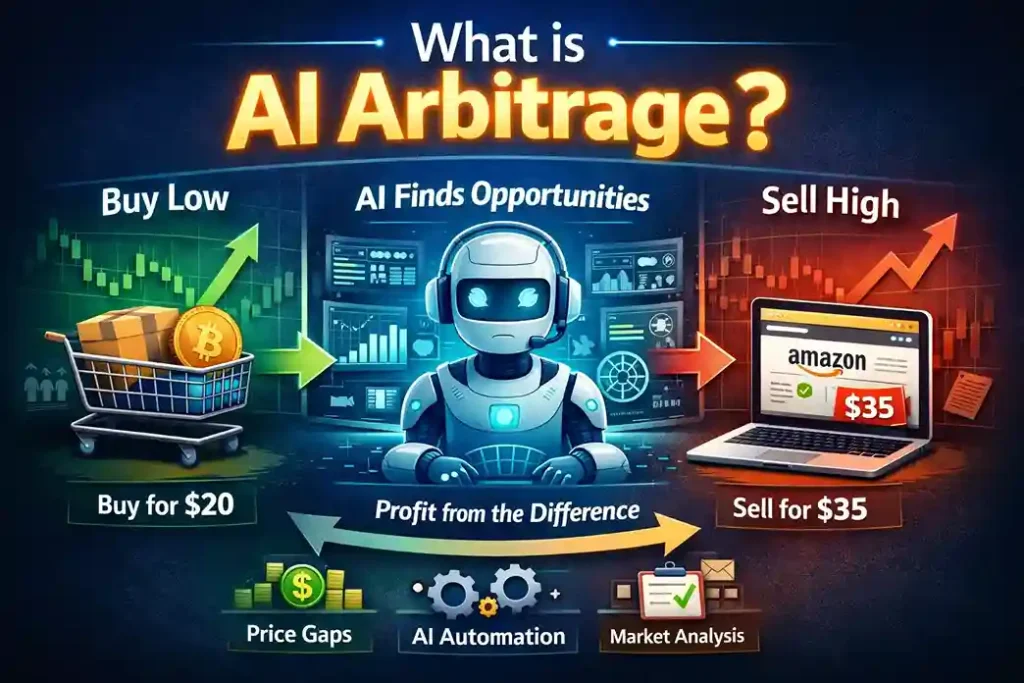
AI arbitrage means using artificial intelligence (AI) to find price, cost, or value differences and profit from them more efficiently than humans can.
In simple terms:
AI arbitrage is using AI to spot opportunities where something is cheaper in one place and more valuable in another — or where work can be done cheaper than what customers are willing to pay.
AI helps by:
- Analyzing large amounts of data quickly
- Detecting patterns humans may miss
- Working 24/7 without manual effort
How Is AI Arbitrage Different From Traditional Arbitrage?
Traditional arbitrage has been around for decades. It usually involves buying something cheap and selling it at a higher price elsewhere.
AI arbitrage improves this process using automation and data.
| Traditional Arbitrage | AI Arbitrage |
|---|---|
| Manual research | AI-driven analysis |
| Slow execution | Real-time decisions |
| Limited scale | Can analyze thousands of items |
| Human errors | Data-based accuracy |
This is why AI arbitrage has grown so quickly in online businesses and digital markets.
Types of AI Arbitrage (Most Articles Miss This)
One major issue I noticed while researching competitors is that most articles explain only one type of AI arbitrage. In reality, there are several.
1. Financial AI Arbitrage (Trading)
This involves AI detecting price differences in:
- Crypto
- Stocks
- Forex
Example:
- Bitcoin is cheaper on one exchange
- AI buys it there and sells it on another exchange
⚠️ In the U.S., this is high-risk and heavily regulated.
2. Retail AI Arbitrage (Reselling)
This is one of the most beginner-friendly models.
AI tools scan:
- Amazon
- Walmart
- Target
- eBay
Example:
- A product costs $20 at Walmart
- The same item sells for $35 on Amazon
- AI helps identify and track these gaps
This model is legal and widely used in the U.S.
3. Service or Agency AI Arbitrage
This is where many agencies use AI quietly.
Example:
- An agency charges $2,000 for a service
- AI helps deliver the work faster and cheaper
- The difference becomes profit
This model is legal, scalable, and sustainable when done ethically.
4. AI Tool or Model Arbitrage
Businesses use:
- Cheaper AI tools
- Open-source models
and still charge premium prices for outcomes.
This is common in:
- Marketing
- Customer support
- Content production
Read also: Is AI Copywriting Worth It? A Practical, No-Nonsense Guide
How Does AI Arbitrage Actually Work?
Here’s a simple step-by-step explanation:
- Data Collection – AI scans prices, demand, or performance
- Pattern Detection – Finds gaps or inefficiencies
- Decision Making – Determines if profit is possible
- Execution – Buy, sell, list, or deliver services
- Learning – AI improves results over time
Can You Really Make Money With AI Arbitrage?
Yes — but results are not guaranteed.
Success depends on:
- Market conditions
- Tools used
- Risk management
- Skill and consistency
Most professionals treat AI arbitrage as a tool for efficiency, not a shortcut to instant wealth.
AI Arbitrage vs Traditional Reselling vs Manual Work
| Factor | Manual | Traditional Arbitrage | AI Arbitrage |
|---|---|---|---|
| Speed | Slow | Medium | Fast |
| Scalability | Low | Medium | High |
| Risk Control | Manual | Moderate | Data-driven |
| Beginner Friendly | Yes | Moderate | Yes (non-trading) |
Common AI Tools Used in AI Arbitrage
While researching competitor content, I noticed many mention tools vaguely. Here’s a clearer breakdown:
- Price monitoring tools
- Market research AI
- Automation platforms
- Listing optimization tools
- Customer support AI
You don’t need coding skills for most of these.
Is AI Arbitrage Legal in the U.S.?
Yes — when done correctly.
Legal:
- Retail reselling
- Service-based AI arbitrage
- Business automation
Regulated:
- Automated trading
- Crypto arbitrage bots
Always follow:
- Platform rules
- U.S. tax laws
- Consumer protection laws
Risks and Downsides of AI Arbitrage
Important risks include:
- Scams promising “guaranteed profits”
- Platform account bans
- Market saturation
- Poor AI tool accuracy
- Hidden fees
AI reduces effort — not responsibility or risk.
Is AI Arbitrage a Scam?
AI arbitrage itself is not a scam, but scams use the term.
🚩 Red flags:
- Guaranteed returns
- “Secret AI system”
- No explanation of how profits are made
Real AI arbitrage:
- Has risks
- Requires learning
- Takes time
Who Is AI Arbitrage Best For?
AI arbitrage works best for:
- Beginners exploring online income
- Side hustlers
- Small business owners
- Agencies looking to increase margins
It’s not ideal for people seeking instant money.
The Future of AI Arbitrage
AI arbitrage is growing because:
- AI tools are becoming affordable
- Automation is increasing
- Businesses want efficiency
Future trends include:
- AI agents working together
- Smarter price prediction
- Safer business automation
Final Thoughts
After carefully researching top-ranking U.S. articles, real business models, and common misconceptions, it’s clear that AI arbitrage is often misunderstood.
The truth is:
- AI arbitrage is not magic
- It’s not guaranteed income
- It is a powerful efficiency strategy when used responsibly
Most successful users treat AI as a support tool, not a replacement for thinking or ethics. When combined with real value creation, transparency, and compliance, AI arbitrage can be a legitimate and sustainable approach.
This guide was created to give you complete, unbiased, and practical information — so you can make informed decisions, not emotional ones.
Frequently Asked Questions (FAQs)
Q: What is AI arbitrage in simple terms?
Using AI to find value or price gaps and profit from them.
Q: Is AI arbitrage legal?
Yes, especially retail and service models in the U.S.
Q: Can beginners try AI arbitrage?
Yes, non-trading models are beginner-friendly.
Q: Does AI arbitrage require coding?
No, most tools are no-code.

I am Harry, a dedicated content writer and SEO enthusiast with 2 years of experience creating clear, engaging, and search-focused content. I love to simplify complex topics, helping readers find exactly what they need, and turning ideas into helpful, well-researched articles that truly add value.