Imagine opening my laptop, typing a one-line prompt, and getting a usable headline, meta description, product description, and three ad variations in under a minute. AI copywriting promises exactly that: speed, scale, and near-instant ideas. But before I hand over my brand voice to an algorithm, I must want a straightforward answer: Is AI copywriting worth it?
The short answer is: yes — with conditions. For more details, I walk through what AI copywriting is, how it works, where it shines, where it falls short, the real trade-offs between ChatGPT / language models and human copywriters, practical templates and tools you’ll actually use (AIDA, PAS, BAB; Jasper, Copy.ai, Wordtune, Grammarly AI), and most importantly actionable, competitor-proof tips nobody else is shouting about. Read on for a balanced, research-informed verdict and a checklist to decide whether AI belongs in your content stack.
Table of Contents
- What Is AI Copywriting?
- How Do AI Copywriting Tools Work?
- Tools And Entities To Know
- Common Use Cases — Where AI Shines
- Where AI Copywriting Falls Short
- Templates: How AI Uses AIDA, PAS, BAB (And Why You Should Know These)
- Cost Vs. Value: What “Worth It” Actually Means
- Ethical, Legal, And Truthfulness Considerations
- Workflow Recipes — Real Setups That Work
- Checklist — Should You Use AI Copywriting?
- My Personal Experience As A Content Writer
- Final verdict — Is AI Copywriting Worth It?
- FAQs
What Is AI Copywriting?
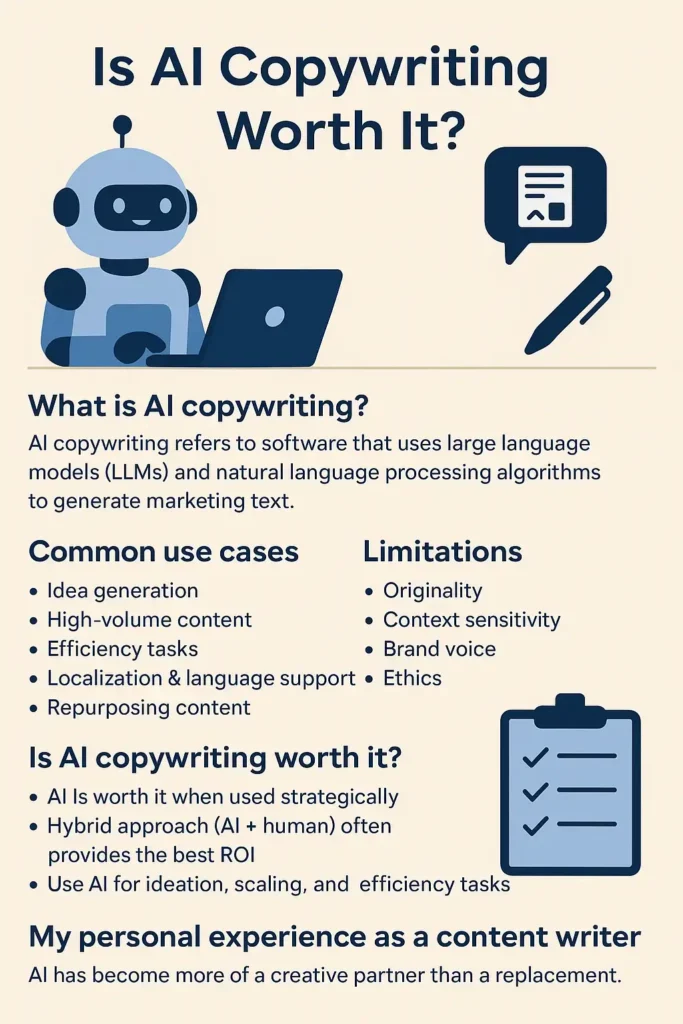
AI copywriting refers to software that uses large language models (LLMs) and other natural language processing algorithms to generate marketing text: headlines, emails, blog outlines, product descriptions, ad copy, social posts, and more. Tools range from simple template-based generators to advanced LLMs (for example, models in the GPT family) that can produce fluent, contextually aware prose given a prompt.
Quick Elements That Make Up AI Copywriting:
- Prompt: the user’s instruction or input (e.g., “Write a 20-word headline for a running shoe aimed at millennials”).
- Template: marketing structures like AIDA, PAS, or BAB that shape output.
- Model/engine: the underlying AI (ChatGPT-style models, specialty tools).
- Post-edit: human review and refinement step (often essential).
How Do AI Copywriting Tools Work?
At a high level, modern AI copywriting tools combine a language model trained on large text corpora with productized templates and UX that help marketers craft prompts. The model predicts the next word sequence conditioned on the prompt and the context. Many tools also add post-processing:
- SEO optimization (keyword injection, meta description length checks)
- Tone controls (casual, professional, witty)
- Plagiarism and grammar checks
- Multilingual translation/localization
Tools like Copy.ai, Jasper, Wordtune, and Grammarly AI wrap these models with interfaces and templates so marketers don’t need to write clever prompts from scratch.
Tools And Entities To Know
- ChatGPT / GPT-based models — generalist LLMs useful for many prompts; can be fine-tuned or prompted carefully for better results.
- Jasper, Copy.ai, and GetGenie — productized AI writing tools with templates and UX targeting marketers.
- Wordtune — focused on paraphrasing and rewriting.
- Grammarly AI — grammar + tone + clarity assistant with emerging generative features.
- Human copywriter — still essential for brand strategy, nuanced storytelling, and high-stakes messaging.
Common Use Cases — Where AI Shines
AI copywriting is especially valuable for the following tasks:
- Idea generation & overcoming writer’s block — quick lists of headlines, hooks, or campaign angles.
- High-volume content snippets — product descriptions for catalogues, short social posts, ad variations for A/B testing.
- Efficiency tasks — meta descriptions, email subject lines, summaries of long documents.
- Localization & language support — drafting content in multiple languages or rephrasing for local tone.
- Repurposing content — turning a blog into a series of tweets or an email sequence.
Hootsuite, Ocoya, and other marketers emphasize these strengths: speed, scale, consistency, SEO assistance, and versatility.
Where AI Copywriting Falls Short
Despite impressive capabilities, AI has real limitations:
- Originality and deep creative insight: AI recombines patterns it has seen; it rarely invents genuinely novel metaphors or brand narratives.
- Context sensitivity: subtle cultural cues, legal constraints, industry jargon nuances may be mishandled.
- Brand voice continuity over long-form storytelling or complex funnel copy often requires a consistent human hand.
- Ethics & confidentiality concerns for sensitive or proprietary prompts.
- Client perception: Some audiences or clients specifically distrust AI-generated content and prefer human provenance.
Good Egg Digital and Lumen & Fox argue that when nuance, brand empathy, or sensitive messaging matters, human copywriters still win.
Templates: How AI Uses AIDA, PAS, BAB (And Why You Should Know These)
Most AI writing tools support classic marketing frameworks:
- AIDA (Attention, Interest, Desire, Action) — great for ad copy and landing pages.
- PAS (Problem, Agitate, Solve) — useful for email sequences and conversions.
- BAB (Before-After-Bridge) — compact framework for product descriptions and hero sections.
Why this matters: templates provide reliable structure but also make AI output formulaic. Use templates for efficiency; combine with human creativity for differentiation.
Practical Examples (What To Expect)
- Ad headlines: AI gives 10–20 variations in seconds — excellent for testing.
- Product descriptions: AI produces acceptable first drafts for long product lists, but will often need brand-specific detail added.
- Blog outlines: AI can create a solid skeleton with subheadings and suggested word counts; human writers add depth, sources, and original research.
- Email sequences: AI writes subject line options, short bodies, and CTAs, which you can refine for personalization.
Important note: real-world tested teams frequently use AI for first drafts, then apply human editing to reach publishable quality.
Cost Vs. Value: What “Worth It” Actually Means
Determining whether AI is “worth it” requires mapping objectives against tradeoffs:
- If you need speed and volume (e.g., hundreds of SKU descriptions), AI often is worth it.
- If you need original brand positioning or legal/technical accuracy, human writers are more valuable.
- If you want both: a hybrid approach (AI drafts + human edits) usually gives the best ROI, cheaper than full human writing but higher quality than raw AI output.
Budget tip: Use AI for repetitive, low-impact tasks and reserve human time for strategic messaging and final voice polishing.
Ethical, Legal, And Truthfulness Considerations
- Misinformation risk: LLMs can confidently hallucinate facts. Always verify claims, stats, and dates.
- Copyright & originality: AI recombines patterns — use plagiarism checks for sensitive content and always add original analysis for unique value.
- Transparency: Some industries require disclosure if content is generated by AI; consider ethical transparency policies.
- Data privacy: Don’t feed proprietary details or PII into third-party AI prompts without understanding provider policies.
Workflow Recipes — Real Setups That Work
- E-commerce product funnel
- AI generates 50 base descriptions → human editor applies brand micro-style + technical checks → QA → publish.
- Content marketing team
- AI drafts outlines + suggested internal links → writer expands with research + interviews → SEO editor optimizes meta and keywords.
- Performance marketing
- AI generates 20 ad variants → run A/B tests → scale winners with human refinement.
Checklist — Should You Use AI Copywriting?
Use this to decide quickly:
- Do you need volume, speed, or multiple variations? → Yes (AI helps).
- Does the copy require legal/technical precision? → No (human or specialist required).
- Is the brand voice subtle, heavily narrative, or emotionally sensitive? → Human.
- Are you prepared to add post-editing hours? → Essential.
- Do you have a micro-style guide and seed sentences? → If yes, AI will work much better.
Closing — How To Start Today (Quick Plan)
- Identify one low-risk, high-volume use case (e.g., product descriptions).
- Create a 6–10 line micro-style guide for your brand.
- Run AI to create first drafts and collect 30 seed sentences from top editors.
- A/B test variations from AI as experimental hypotheses.
- Implement quarterly ‘source drift’ audits.
My Personal Experience As A Content Writer
From my own experience as a content writer, AI has become more of a creative partner than a replacement. It helps me brainstorm angles, outline faster, and overcome writer’s block on busy days, but the real value still comes from refining the ideas, adding depth, and shaping the final message with a human touch. Using AI strategically has allowed me to take on more projects without compromising quality, proving that when handled right, AI can enhance your workflow, not replace your craft
Final verdict — Is AI Copywriting Worth It?
Yes — with conditions. AI copywriting is worth it when used strategically: for ideation, scale, efficiency, and experimentation. It becomes truly valuable when paired with human judgment, brand micro-style prompts, and a robust editing workflow. If your aim is to save on routine, repetitive writing tasks and accelerate testing, AI will pay for itself quickly. If your aim is to create original brand storytelling or legally sensitive content, rely on experienced human writers.
Remember the unique operational tips above: treat AI as a differential filter, build micro-style prompts, use seed sentences, and audit for drift — these practical moves turn raw AI capability into a durable advantage.
FAQs
Q: Will AI replace copywriters?
A: Not completely. It will replace some repetitive tasks, but human copywriters who can strategize, brief, edit, and add original insight will still be in high demand.
Q: Are AI outputs copyrighted?
A: Copyright law is evolving. Best practice: heavily human-edited outputs, or add original human authorship to ensure stronger copyright claims.
Q: Is AI good for SEO?
A: AI can help craft SEO-friendly meta content and structure, but it won’t replace keyword research, topical authority building, or link acquisition strategies.
Q: Can you make money with AI copywriting?
A: Yes, you can make money with AI copywriting. Many freelancers and agencies use AI tools to speed up content creation, take on more clients, offer faster delivery, and create services like blog writing, product descriptions, social media posts, ad copy, and email sequences. The key is to combine AI with human editing, creativity, and strategy — clients pay for quality, not raw AI output.

I am Harry, a dedicated content writer and SEO enthusiast with 2 years of experience creating clear, engaging, and search-focused content. I love to simplify complex topics, helping readers find exactly what they need, and turning ideas into helpful, well-researched articles that truly add value.